Single companies fail for unforecastable reasons
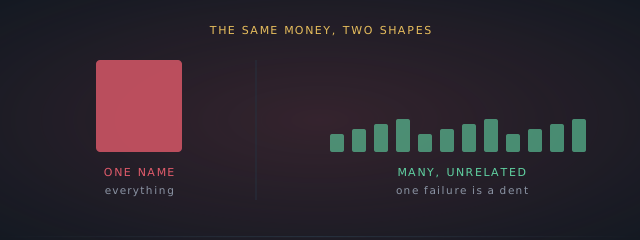
A fraud is uncovered. A trial fails. A founder leaves, a regulator arrives, a factory burns, a competitor undercuts. None of these appear in the chart beforehand, and no amount of reading the financials reliably anticipates them. Across the whole market these events are a manageable background rate. Inside one position, one of them is everything.
The risk you are not compensated for
Finance draws a useful line between risk that is unavoidable if you want a return, and risk that is specific to one company and can be diluted for free by holding more than one. The market does not pay you extra for carrying the second kind, because you did not have to. Concentration means accepting a risk with no expected compensation attached, which is a bad trade before the outcome is known.
Correlation hides it
Holding eight names feels diversified. If they are eight companies in the same sector, they largely rise and fall together, and in a sector-wide shock you own one bet in eight envelopes. Real diversification is about things that fail for different reasons, not about the number of tickers on the screen.
Position sizing is the honest version
None of this argues against ever holding a single stock. It argues for sizing it so that being wrong is survivable: that a total loss on any one position is a setback rather than the end. The uncomfortable test is to ask what happens to your account if this specific holding goes to zero next week, and to answer honestly before rather than after. In the crash year Live a Life schedules, a single company falls 45% while the whole index falls 32%: the same storm, a deeper hole for the one-name portfolio.
Questions
Frequently asked
How many stocks is diversified?
The benefit rises quickly with the first several holdings and then flattens, but count matters less than variety: names that fail for different reasons diversify, names in one sector largely do not.
Is holding one stock always a mistake?
Not inherently: it is a question of size. The risk is not owning a single company; it is owning it in a size where its failure ends the account.
What is unsystematic risk?
Risk specific to one company rather than the market as a whole. It can be reduced by holding more, unrelated positions, which is why the market does not pay a premium for carrying it.