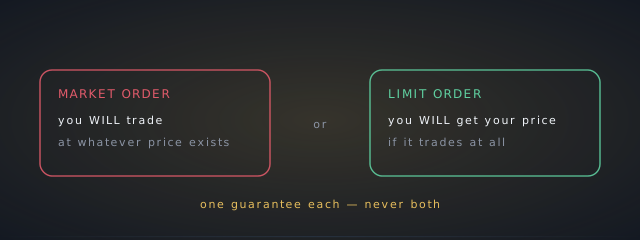
The market order: certainty of execution
A market order says fill me now, at whatever is available. In a calm, liquid stock this is fine: you get roughly the price on your screen. In a fast or thin market it can fill noticeably worse, because it walks up the queue of sellers until it finds enough shares. The price you saw was a snapshot, not a promise.
The limit order: certainty of price
A limit order says fill me at this price or better, otherwise wait. You will never pay more than you specified. The trade-off is that you may not trade at all, and if the price runs away, you watch it go. For a new trader that feels like the worse outcome, and it usually is not: missing a trade costs you nothing, while a bad fill costs you money immediately.
Where market orders quietly hurt
Right at the open, when prices are unsettled. In anything thinly traded, where the queue is short. Around news, when the spread has widened. And in options, where spreads are frequently wide enough that a market order can hand away a meaningful chunk of the position before it has done anything. Those are precisely the moments urgency makes market orders tempting.
A reasonable default
For an ordinary trade in a large, liquid name, a market order is unlikely to hurt you. Everywhere else (anything thin, anything fast, anything with a wide spread, and any options contract) a limit order costs one extra field and removes the entire category of surprise. The habit worth building is noticing which situation you are in before you tap.
Questions
Frequently asked
Which order type should a beginner use?
Limit orders when it matters (thin stocks, volatile moments, options) because they remove the risk of a surprise fill. Market orders are usually harmless in large, liquid names during calm periods.
What is slippage?
The difference between the price you expected and the price you actually got. It is what a market order can produce when the market moves or the queue is thin between your tap and your fill.
Why did my limit order not fill?
Because the price never reached your limit, or it did but there were not enough shares at that price ahead of you in the queue. A limit order guarantees your price, never your execution.