What it actually does
A stop-loss sits dormant until the price reaches a level you chose, then fires an order to get you out. Its value is almost entirely psychological: it converts an emotional decision under pressure into an arithmetic one made while calm. That is a bigger advantage than it sounds, because the moment you most need to think clearly is precisely the moment you cannot.
Stop-market versus stop-limit
A plain stop becomes a market order when triggered: you will get out, but at whatever price exists. A stop-limit becomes a limit order: you control the price but may not get out at all if the market races past your limit. Each fails in the opposite direction, and neither is universally correct: one risks a bad fill, the other risks no fill.
Gaps: the failure a stop cannot protect against
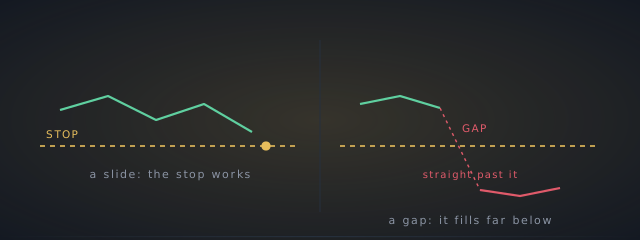
A stop is not a floor. If a stock closes at 50 and opens at 38 after news overnight, a stop at 47 does not fill at 47: there was no trading between those prices. It fills near 38. This surprises people badly, and it is worth internalising before rather than after: a stop limits the damage from a slide, not from a jump.
Where people place them badly
Two common errors. Too tight, so ordinary noise stops you out of a position that then does exactly what you expected: a stop needs room for the instrument’s normal wiggle. And placed at obvious round numbers where everyone else has clustered theirs, which is where cascades happen. The useful question is not "how much am I willing to lose" but "what price would prove my reason for being here was wrong".
Questions
Frequently asked
Does a stop-loss guarantee I lose no more than that amount?
No. It triggers at your level but fills at whatever the market offers next. In a gap or a fast collapse that can be materially worse, which is the one thing stops cannot protect against.
What percentage should my stop be?
There is no universal number. What can be said is that a stop tighter than the instrument’s normal daily movement will be hit by noise rather than by being wrong.
Do I need a stop on every trade?
Not necessarily, but you do need an exit plan on every trade. A stop is one way to make that plan automatic; deciding in advance what would change your mind is the part that matters.