It multiplies both directions identically
This is the part people nod at and do not absorb. At two times leverage, a 10% rise doubles to 20%, and a 10% fall does too. Leverage is not an edge and does not improve your odds; it is a volume knob on an outcome you have not changed. If a strategy loses money slowly, leverage makes it lose money quickly.
The maintenance level
Your broker requires your own equity to stay above a fraction of the position. Fall below it and you get a margin call: add money, or the broker sells. In fast markets there may be no warning and no conversation: positions are simply closed. The broker is protecting its loan, and its right to do that was in the agreement you accepted.
Why it triggers at the worst possible moment
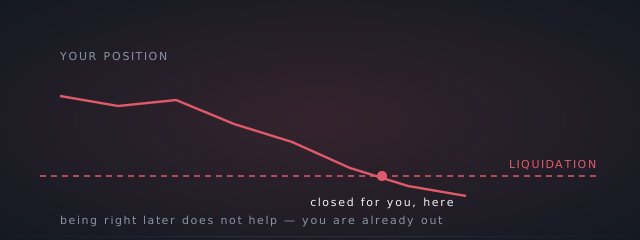
By construction, a margin call arrives when the price has already moved against you: often in a panic, when the spread is wide and the price is at its least favourable. Plenty of traders are eventually proved right about a direction and are liquidated before eventually arrives. Being right is not sufficient; you also have to still be in the position.
What it costs beyond the loss
Borrowed money charges interest for as long as you hold, quietly eroding a position that goes nowhere. Forced sales crystallise a loss at the worst price of the move. And the psychological effect is real: leverage makes ordinary volatility feel unbearable, which produces exactly the panicked decisions that cause the damage.
Questions
Frequently asked
What happens in a margin call?
Your broker requires more money to restore the minimum equity. If you do not or cannot supply it quickly, it sells your positions: often automatically, sometimes without prior contact, at whatever price is available.
Can I lose more than I put in?
With borrowed money, yes. In a sharp gap the position can be closed below the point where your equity covers the loan, leaving you owing the difference. Unleveraged cash positions cannot go below zero.
Is leverage ever sensible?
Professionals use it with strict position sizing and predefined exits. What makes it dangerous for beginners is not the tool but the combination of an unplanned exit and a position too large to survive normal volatility.