Three things have to go right, not one
With a share you need direction. With an option you need direction, magnitude and timing. The price must move the way you expected, far enough to cover what you paid, before expiry. Two out of three loses. This is why so many beginners report being right about a stock and losing money anyway: they were, and the contract expired before the market agreed.
Time decay works against the buyer every day
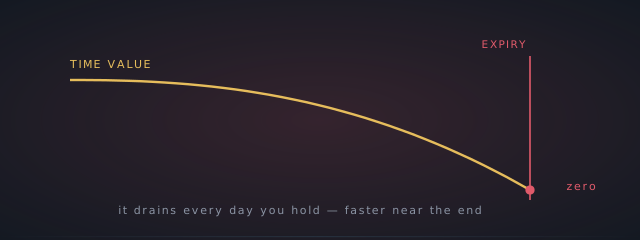
An option’s value contains a component for time remaining, and that component erodes continuously, accelerating as expiry approaches. Hold overnight and it is worth slightly less purely because a day passed. When you buy an option you take a position that loses money by default and must outrun that drain.
Why the cheapest contracts are cheap
A contract costing a few cents is priced there because the market judges it very unlikely to pay. It is not a bargain; it is a long shot correctly priced as one. The lottery-ticket appeal is exactly the problem: the payoff is enormous, the probability is small, and buying many of them converts a small account into a series of expiries.
Selling is a different animal entirely
Buying an option caps your loss at what you paid. Selling one can expose you to losses far larger than the premium received, in some configurations, theoretically unlimited. Brokers gate these behind approval levels for a reason. The distinction between buying and selling matters far more than which strike you pick.
Questions
Frequently asked
Can I lose more than I paid for an option?
As a buyer, no: the premium is your maximum loss. As a seller, yes, and potentially a great deal more, which is why brokers restrict selling to higher approval levels.
Why did my option lose money when the stock went up?
Most commonly time decay outpaced the move, or the move was too small to cover what you paid, or implied volatility fell after you bought. Direction alone is not enough.
Are options good for beginners?
They are materially more complex than shares and add deadlines and volatility effects to a decision that was already hard. The complexity is real and the failure modes are unforgiving.