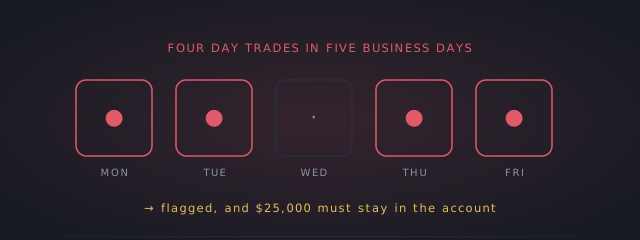
What the old rule did
Buying and selling the same security on the same trading day was a day trade. Four of them inside five rolling business days in a margin account flagged the account, and a flagged account had to keep at least $25,000 in cash and eligible securities. Below that, day trading was restricted, commonly for ninety days. The count rolled rather than resetting each week, which is why people were caught on a Tuesday.
What replaced it
FINRA's Regulatory Notice 26-10, approved by the SEC in April 2026, replaced the day trading rules in their entirety with intraday margin requirements, effective June 4, 2026. There is no count of day trades and no pattern day trader label. Your broker checks through the day that the equity in your margin account covers the positions you hold right then: at least 25% of their current value, with $2,000 the least a margin account can hold to trade on margin at all.
When an account falls short
If your positions grow faster than your equity, the account has an intraday margin deficit, and you are expected to cover it as promptly as possible. Fall short again and again and the broker can restrict the account for up to 90 days. The difference from the old rule is what it watches: how much you hold against how much you own, not how many times you traded.
What still catches beginners
Brokers that need time to change their systems have until October 20, 2027, so the old count can still appear at a firm that has not switched. A cash account sat outside both rules and still has its own limit: money from a sale is not available again until the trade settles. And the reasoning behind both rules is unchanged: frequent trading with borrowed money remains high risk.
Questions
Frequently asked
Does the $25,000 rule still apply?
Not since June 4, 2026, when FINRA's intraday margin requirements replaced it. Brokers have until October 20, 2027 to change their systems, so the old restriction can still appear at a firm that has not switched yet.
Does it apply to a cash account?
Neither rule does. A cash account has a different limit, settlement: money from a sale is not available to trade again until the trade settles, which limits how often you can trade in its own way.
Does it apply outside the United States?
These are US rules. Other jurisdictions have their own frameworks, often built on leverage limits and mandatory risk warnings rather than a count of trades.