Volatility is the honest definition
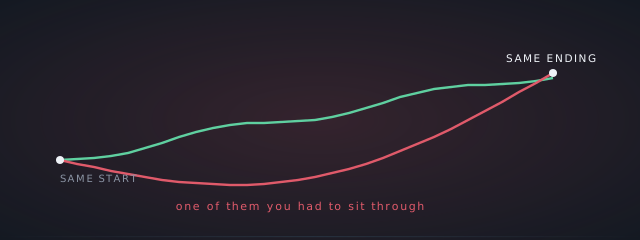
People hear risk and think chance of losing everything. In practice the working definition is the size of the swings you have to sit through. A wild path and a calm path can produce identical results, but only for someone who stayed on the wild one the whole way, which is exactly the assumption that tends to fail.
The drop is where the damage happens
Here is the honest part: most people who quit, quit near the bottom of a swing they did not expect. The loss becomes permanent at the moment of selling, not at the moment of falling. A portfolio that would have recovered fully is turned into a realised loss by a decision made in the worst week. That is why knowing your own tolerance in advance matters more than any forecast. And the arithmetic is lopsided: a fall of 50% needs a gain of 100% just to get back to even.
Risk you cannot see is still risk
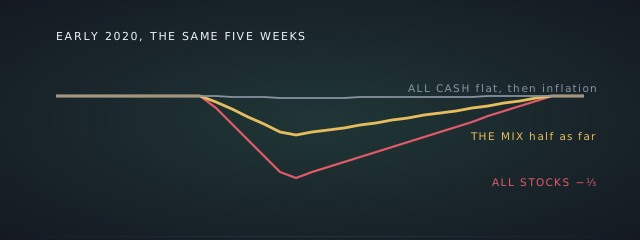
Things that rarely move are not automatically safe. Cash barely fluctuates and loses purchasing power steadily to inflation: a slow, invisible risk with no dramatic chart. Something illiquid may show a calm price simply because it trades rarely. Absence of visible movement is not the same as absence of risk.
The practical question
Not "how much could I make" but "how far down can this go, and what would I do there". Answering that while calm, and sizing accordingly, is the whole discipline. Everything else (the analysis, the timing, the charts) is downstream of whether you are still holding when it matters.
Guess first
Down by half.
A $1,000 portfolio falls 50% in a crash, to $500. What gain does it need just to get back to $1,000?
$1,000 × (1 − 0.50) = $500 · back to $1,000 needs $500 more on $500: +100%. A fall of 20% needs +25%; a fall of a third, +50%.
Losses and gains are not mirror images. The deeper the fall, the steeper the climb back. All eight in Guess first
Questions
Frequently asked
Is risk the same as losing money?
Not quite. Risk usually describes the range and size of possible outcomes, including the swings along the way. A permanent loss is one outcome; volatility is the road, and the road is what causes most people to abandon the trip.
Is cash risk-free?
It is stable in nominal terms and loses purchasing power to inflation over time. That is a real risk, just a quiet one with no alarming chart to react to.
How do I know my risk tolerance?
The honest test is behavioural rather than a questionnaire: what you actually did, or would do, when a holding fell sharply. Most people discover it in a drawdown, which is an expensive place to learn.